In the afternoon, I went to this workshop: "Let America be American Again: (Re)Considering the American Dream through the Eyes of Those Who Critique and Challenge America to be "True" to Her Roots.
It was led by Miguel Lopez, a seventh-grade teacher and teacher educator in Salinas. He was amazing. Seriously, I almost teared up a couple of times. I compiled the notes I took on the syllabus/bibliography he gave us. My thoughts are stuck in throughout, unmarked, and the writing is rather slippery between you and I, but you'll get the idea. Syllabus/Bibliography here. Heart. Heart him. Step One: Write words you associate with "immigrant," "immigration," and "The American Dream" on a green piece of paper. Step Two: Why are you here in this workshop? Write a question you have, or a philosophy, or a statement about something on a red piece of paper. Step Three: Crumple those papers up as tight as you can and throw them at people. Pick up those that have fallen near you and throw them at other people. Continue throwing, let it snow colored balls all around you. When the snowing subsides, pick up one or two that have made their way toward you. Step Four: Share the red paper, those who would like to. Share the green paper, those who would like to. Ask questions. Go deeper. We have opened up a safe space for expression and critique. Do this with your students. The first month, you'll get nothing. The second month, you'll get nothing. The third month, though, your students will start speaking. Critiquing. They're thinking now, expressing opinions, gripes, things that they love. Step Five: I am abandoning this system of steps. There is too much to talk about. There is too much to share with you. The world is so full of a number of things, I'm sure we should all be as happy as kings. By the way, so are the content standards. Read through them. They allow for everything you could ever dream of wanting to do. You can justify a trip to the moon - third grade curriculum standards require a lesson on space travel perhaps. I think of this as countering the deficit thinking about curriculum standards. Think of them like you think of linguistic grammar teaching. They are a wealthy, joyous, fecund, full and fabulous language to let you express whatever you want. Your goal for your students is an understanding of the theme of your unit. Keep them main goal in sight. There are any number of ways they can get there (standards: voice, descriptive language, metaphor, meter, etc.). Oh, hey, also, rethink the how and the why of your curriculum. We as teachers must have a personal relationship with our curriculum--a deep intellectual and emotional connection with curriculum. We must express this to our students. We must tell them why we care so that they know why to care, so that they can make an informed decision about whether or not to engage. Give them the tools they need to make intelligent choices. READ Subtractive Schooling, Angela Valenzuela Hope on a Tight Rope, Cornell West. What is the difference between optimism and hope. One is grounded in reality and one is not. I'm not quite sure which, but he likes hope and looks down on optimism. YOU MUST Know your curriculum and your text backward and forward and sideways and slantways because YOUR JOB, like a preschool teacher, or a montessori school teacher is to WATCH AND RESPOND. And when you respond to a students' interactions with text, to their questions, their interests, their dancing around, you have to know HOW to respond and WHERE to go. DEALING WITH KIDS WHO DON'T COME TO CLASS This is why you read Subtractive Schooling FIRST, you ask the class, what have I done that you are so mad at me that you don't want to come to my class? What have I done to have make you see hypocrisy in my teaching, so that you do not want to engage? I want to atone for, to make better, anything I have done. After you have accounted for any of your own wrongdoing, THEN you can ask the particular student's friends. You should know who he hangs out with: go to them and ask them what is going on. Tell them to relay to him that he has responsibilities here, that I need him here. Give them the text/curriculum to pass on to him. Put a note inside that says "you have a lot to offer this discussion, this learning time. You have a lot to offer your brothers in the class. Please, bring it in to the class. Share what you have with us. NEVER assume that he doesn't care about the class, about his education. He is probably posturing for one reason or another. Adolescents do this. He wants to be acknowledged by someone (granted, she is probably a lot cuter and younger than you), but pursue him. Make him feel acknowledged and wanted, pursued, as by a lover. Do not do this in a way that embarrasses him. There is time for that in class. CONTEXTUALIZE THE TEXTS YOU USE Langston Hughes was part of the Harlem Renaissance, he experienced poverty, his father left and he was angry. He stands on the shoulders of Phyllis Wheatley and others. Also, connect all your texts with larger themes and big ideas. Also, connect all your texts to one another. Also, READ ALOUD. Language acquisition and literacy theory shows that students who are read to make much larger strides in reading. We decide at 3rd grade or so thatstudents should move to reading on their own to be more young-adult. But if you have students who are struggling, why not continue doing the thing that proves most effective. READ to your students. ONE WAY I TEACH A POEM I blow it up and hang it on the wall. 8 sheets for "Let America be America again." You can cover it with plastic if you want to use it over again, and use vis a vis markers. One color for each standard or focus. Let's make "voice" purple. Do not define voice for your students. Ask them to look for instances of voice or instances of the poet expressing his voice, making his voice, etc. Let them decide for themselves what it means. You know where they need to go, and you can guide them there eventually. Tell them to "tag" the poem, to mark it up. The subversiveness is good for them. Take a day to play with voice. Do another idea, e.g., figurative language, the next day, in another color. Each night, do your homework, respond to where the students are going, make sure you know the intricacies of your text and outside evidence as it relates to their needs and interests, the steps they are taking, the choices they are making. If you don't know it, don't bluff it. Create scripted coincidences for them: "You will never guess what I heard on NPR last night. Exactly what we talked about yesterday." Eventually, they'll know you're lying. Does it matter? I don't think it matters. You're creating imagined moments of kismet, of magic, of coincidence. They are no less useful and wonderful than the real thing. You have to know when the evidence is in the text and when it is not, so you know when to direct them back to the text and when to look for evidence outside the text (we call that extrinsic evidence in law) text-text text-self text-world At the end, as a class, we find the best example of each color. Students must argue for their choice. They are accountable for the information we've discussed and they are given the space to take it further. The next year, the new students start with the work of the students before. The 8th graders become the mentors of the 7th graders. We are a community of learners. Invest in the whole community of the school. I do not stop caring about my students when they are no longer my students. I affirm their work by allowing them to help the next group. I tell the new seventh graders this has already been distilled for you. You are standing on the shoulders of those who came before you. (I may hide the legend, what the colors represent. Make them figure it out.) And then they do a different text from scratch. Requiring them to schlock through a text is not a virtue. That is not what we are here to teach. Do not force them to take notes. They have the choice to or not, but keep them accountable, so they learn quickly the benefit of it. Pair those that fail up with students (you've asked in advance) who take notes so they can see it modeled. Your job is to make sure they are engaged, it is not to police them. Freedom. Democracy. Everything in my classroom is democratic up to the point of the grade: standards, skills, etc. I go where their interest takes them. If we don't cover what we need to, THEN I introduce it. Kids can and do memorize a lot of things, song lyrics, commercials. Get them to memorize the good stuff, give them an internal wealth of language and ideas to draw from. If a piece bombs, revisit whether you're going to do the next one in the series. THE GALLERY WALK Cut up picture books, mount them nicely, treat them as the art they are. For instance, We are America, by Walter Dean Myers, or anything by Children's Book Press. Hang the pages in order, cover the text with sticky notes and have the kids do K/W/L with the images as text. Picture books remind students of childhood; they bring out good feelings. They are easier to engage in and are good into activities, or activities for struggling readers. Picture books are better than many novels, they have to do so much with so little texts, like poems. So many ideas packed into such a small space. Later, remove the sticky notes. How did their interpretations of the images differ with the text. Nothing is wrong. REMEMBER: Captain America was a recruiting tool in WWII. How do you feel about patriotism now? MARIA TESTA: YA book: Something about America. Two parts, mirror reflection of one another, one literal, one metaphorical. Cut this up too. Put all the pages on a board. Have students connect words, ideas that come up with colored string, tacking it in place and making a web. It is hard for struggling readers to see connections between a scene in the beginning of the book and something later. This book sounds great. The narrator is a girl whose family emigrated from Kosovo and now lives in a Maine town where there are so many Somali immigrants that the Mayor asks the ambassador to keep them from coming into their town. Her father leads the rally in support of the Somalis. Let America be America Again! Here's that linking of texts with big ideas I talked about. At the end, the father takes his daughter to meet a Somali mother and child. The mother asks the father "Where was your war?" My freedom is inextricably linked with yours. Langston links black civil rights struggles with immigrant rights. We are all beneficiaries of the civil rights movement. We are connected to all causes and all causes are connected. "Where was your war?" Romare Bearden: Collage artist Collage with stamps being released of him by the USPS "Curriculum by Design" GO TO National Steinbeck Center in Salinas Of Mice and Men as Graphic Novel Exhibit right now This post was also published on MUSE '13 |
Monday, October 10, 2011
From MUSE: I am in love with Miguel G. Lopez

Friday, September 30, 2011
I needed this today
Late Summer, Early Fall
by Sherman Alexie
She catches a moth, stunned
By sun and windows,
Cradles it outside, uncups
Her hands and lets it fly.
How often do we humans save
What can be saved? This
Morning, a young woman
Has redeemed our kind
By releasing a moth. O,
She half-spins
And laughs. And her laughter
Flutters along
With the moth.
This woman catches me
Watching her. I laugh and catch
my breath. Make a note.
Today, at 10:42 a.m.,
Beauty defeated death.
Thank you, Verda
Sunday, September 25, 2011
Teaching Writing
My semester is in full swing and is exhausting so far. During the day I student teach with an 10th grade ELD teacher at Mission High School, and in the evenings I go to class at UC Berkeley. My weekends are mostly spent doing homework and preparing lesson plans. Luckily, I love it, or I'd have crapped out already.
Today, I'm planning for next week. My intermediate students will be learning about thesis statements, and before I planned the details of the lesson, I wanted to make sure I was clear on where the process of developing a thesis statement and its supporting evidence fits into the larger concept of writing and learning to write.
This is what I've come up with so far. I drew from the canons of rhetoric described at Silva Rhetoricae (which is a fantastic site, by the way) and added my own thoughts about what fits in where.
Today, I'm planning for next week. My intermediate students will be learning about thesis statements, and before I planned the details of the lesson, I wanted to make sure I was clear on where the process of developing a thesis statement and its supporting evidence fits into the larger concept of writing and learning to write.
This is what I've come up with so far. I drew from the canons of rhetoric described at Silva Rhetoricae (which is a fantastic site, by the way) and added my own thoughts about what fits in where.
RHETORIC
EFFECTIVE WRITING
Invention: What do I want to say?
Topic
Thesis statements
Supporting Points
Arrangement: In what order will I say it?
Logical ordering of evidence
Transposition
Placement of rhetorical devices
Style: How will I express my ideas?
Audience
Tone
Figures of speech
Appeals
Grammar
Diction
Memory: How well do I know my topic? Can I discuss its intricacies? Can I extrapolate on various points? Do I know what others think about it? Can I present my argument in other media? Can I present my argument in other contexts?
Delivery: How do I present my finished work?
These canons of rhetoric cannot be considered merely linearly. They inform one another and require repeated circling back.
For example, I cannot narrow down what I am going to say (invention) until I understand the topic. Understanding the topic is an aspect of memory work. Similarly, in determining what I am going to say, I must consider my audience, as certain arguments are more relevant to certain audiences.

Sunday, July 24, 2011
"Tort Tales" and Access to Courts
The popular narrative that grew around the Liebeck suit is what political scientists William Halton and Michael McCann refer to in their definitive book Distorting the Law as a “tort tale.” Tort tales are narratives about lawsuits developed for the purposes of politics and popular culture, and as McCann explains are usually “either completely fictional accounts or highly fictionalized, reconstructed accounts of actual events.” Substituting half-truths and outright falsehoods for actual facts made a joke of a sad story about a 79-year old woman who suffered severe injuries because of an unnecessarily dangerous product from a very wealthy corporation.From a review of a new HBO documentary Hot Coffee by Scott Lemieux (of Lawyers, Guns, and Money)
If tort tales were merely fodder for sitcoms and comedians, the distortions might be harmless. But these tales are often used (and sometimes created) for political purposes. A major strength of Saladoff’s documentary is that she links the false narrative about the McDonald’s coffee case to a larger - and pernicious - political cause. Tort reform groups funded by corporations have used the fictionalized portrayal of the Liebeck suit and other tort tales to compel legislatures to limit access to the courts and place arbitrary caps on damages.
Wednesday, July 13, 2011
Newspapers Good and Bad
David Carr of the NYT finds a nugget of hope in the News of the World scandal:
Thanks, TNC
A newspaperman insisting newspapers are still relevant, perhaps. I am hopeful and uplifted nonetheless.Still, how did we find out that a British tabloid was hacking thousands of voice mails of private citizens? Not from the British government, with its wan, inconclusive investigations, but from other newspapers...
Newspapers, it turns out, are still powerful things, and not just in the way that Mr. Murdoch has historically deployed them. The Guardian stayed on the phone-hacking story like a dog on a meat bone, acting very much in the British tradition of a crusading press, and goosing the story back to life after years of dormancy...
Mr. Murdoch, ever the populist, prefers his crusades to be built on chronic ridicule and bombast. But as The Guardian has shown, the steady accretion of fact -- an exercise Mr. Murdoch has historically regarded as bland and elitist -- can have a profound effect.
His corporation may be able to pick governments, but holding them accountable is also in the realm of newspaper journalism, an earnest concept of public service that has rarely been of much interest to him.
Thanks, TNC
Friday, July 8, 2011
Losing
My grandmother had her first child at 16; she became a grandmother at 42. 42! I have friends that age, who, like me, chose graduate degrees, careers (2nd careers!), travel, sometimes mortgages over marriage and babies. Those could wait. At 20, the flesh was willing, but the mind...not so much.
And now, now that we've decided we are ready, now that we yearn for those children we put off having, our bodies are unsure. We work at pregnancy the same way we worked at school, with the same dedication we put into demanding jobs. So much less predictable, though. So much more fragile.
I wrote these lines a year ago, more, with one specific friend in mind who had just lost a child. Sadly, she's no longer alone. We've made choices, good choices no doubt. But choices nonetheless, leaving other paths untrodden.
We continue to yearn.
Lines for ___
And now, now that we've decided we are ready, now that we yearn for those children we put off having, our bodies are unsure. We work at pregnancy the same way we worked at school, with the same dedication we put into demanding jobs. So much less predictable, though. So much more fragile.
I wrote these lines a year ago, more, with one specific friend in mind who had just lost a child. Sadly, she's no longer alone. We've made choices, good choices no doubt. But choices nonetheless, leaving other paths untrodden.
We continue to yearn.
Lines for ___
A moment I did hold my breath and her.
Then the name passed as a whisper through my lips,
Nearly lost and barely heard. The sips
I took of ecstasy that day did sear
My throat and burned their way into my womb.
The susurrations pierced and tore, and she
Ate all of me. I murmured, agonied,
That name—my heart, my head, my soul consumed.
She does not grow, but still I have been wrecked,
Depleted, paled. A near-forgotten word
Leaps to my tongue unbidden and unchecked.
My breath takes form. My prayer ignites in flame,
And she burns up; deaf heaven has not heard.
I'm left among the ashes of her name.
Summer Time
Well, May and June passed in a whirlwind of getting married, honeymooning, and starting school. I'll write about the two big things once I have some time to correlate all the lovely pictures and all the lovely memories. Here we are in July, though, and I've been thinking about you and about how lovely the summer is.
After getting back from Italy, I had about two weeks before school started. I spent it reconnecting, lazing, swimming, and falling back into the pace of normal life.
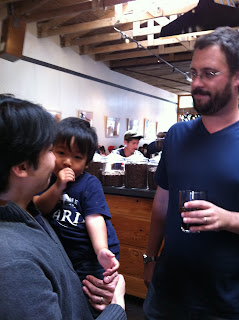 The weekend after Phil returned to work, we met up with D&N and Skylan to check out the underground market and then, kimchi in hand, headed to Four Barrel for some much needed American Coffee. Espresso is delicious, Americanos are not. Nowhere in Italy can you get brewed coffee, especially not delicious Four Barrel!
I did quite a bit of gardening the rest of the week - which meant I got to hang out with Nori quite a bit for nursery trips and things!! I planted tomatoes, eggplant, anaheim peppers, taragon, basil (sadly, only one of the three basil plants survived), strawberries, pansies, lobelia, oregano, thyme, society garlic, and a sweet pea. I also spruced up the rest of my little potted paradise, and everyone seemed to be happy with the tune up and the warm weather!

Buddy got his own kitty grass. He goes out every morning and evening for a little salad, sometimes--bastard--with a side dish of pansy.

I also got some serious girl time in: Summer and Sarah and I spent a couple of nights in Discovery Bay (see dance party, left), and Nori and Khai and I hung out with their beautiful boys. Auntie Nessa got some goooood baby time in--and some good lady time (at awesome Skates' on the Bay happy hour - I hadn't been there since Junior Prom night!).
There have been lots of other catchings-up since then, as well. A wedding takes a lot out of you. It's nice to get back into the normal rhythm and flow of life and family and friends.
After getting back from Italy, I had about two weeks before school started. I spent it reconnecting, lazing, swimming, and falling back into the pace of normal life.

I did quite a bit of gardening the rest of the week - which meant I got to hang out with Nori quite a bit for nursery trips and things!! I planted tomatoes, eggplant, anaheim peppers, taragon, basil (sadly, only one of the three basil plants survived), strawberries, pansies, lobelia, oregano, thyme, society garlic, and a sweet pea. I also spruced up the rest of my little potted paradise, and everyone seemed to be happy with the tune up and the warm weather!

Buddy got his own kitty grass. He goes out every morning and evening for a little salad, sometimes--bastard--with a side dish of pansy.

I also got some serious girl time in: Summer and Sarah and I spent a couple of nights in Discovery Bay (see dance party, left), and Nori and Khai and I hung out with their beautiful boys. Auntie Nessa got some goooood baby time in--and some good lady time (at awesome Skates' on the Bay happy hour - I hadn't been there since Junior Prom night!).
There have been lots of other catchings-up since then, as well. A wedding takes a lot out of you. It's nice to get back into the normal rhythm and flow of life and family and friends.
Subscribe to:
Posts (Atom)