Saturday, February 23, 2013

"For what you do,/ somehow, .../ to my mind with just your voice, so that/ everything I once was sure of seems wrong"


from “No Word, No Sign” by Aaron Kunin

There’s no word for you. There’s no word
for what you do to me. For what you do,
somehow, and you don’t know you do it,
to my mind with just your voice, so that

everything I once was sure of seems wrong;
for what you do to my way of seeing,
so that I start to doubt my own eyes if
what my eyes report isn’t just like what

I hear you say; and for what you do to
my voice to keep it from talking, to keep down
every word somewhere where I can’t remember
it: for this, there’s no word. To me

you’re like a machine without a purpose,
whose purpose is to cast doubt on every
idea that my mind is thinking, and
the end of every idea is you.

Monday, January 28, 2013

Living a Better Story

Some thoughts on writing from Nick Hornby and Kid President whoisawesomeandijustdiscoveredhimomg!


Monday, January 21, 2013

The importance of the wandering mind: "How can one know where reading books ends and dreaming in books begins?"

New research continues to emphasize the importance of mind wandering for learning. It turns out that not paying attention is one of the best ways of discovering new ideas. Reading books, whether silently or aloud, remains one of the most efficient means of enabling such errant thinking. As our bodies rest, our minds begin to work in a different way. New connections, new pathways, and sharp turns are being made as we meander our way through the book, but also away from it. There is no way to tell if anyone is actually paying attention anymore as I read, including myself. This seems to be one of the great benefits of reading aloud, that you can think of something else while you do it. We may be holding the book together, but our minds are no doubt far apart by now. The fairy tale is the first story of childhood because it tells of such leaving behind (parents and home), of entering the dreamscape of the woods - and the mind. It tells of the crooked path of change. How can one know where reading books ends and dreaming in books begins? - Andrew Piper
 from lit-hum.org

Monday, December 31, 2012

Burning the Old Year

I feel like so much of this year was good solid stones, and I feel blessed.  This is beautiful, though, and tonight I hope you dance in the burning of those ephemeral things, twist and float like pieces of char in a fire and wake up in the new year baptized and sanctified by the flame.

Burning the Old Year

BY NAOMI SHIHAB NYE
Letters swallow themselves in seconds.   
Notes friends tied to the doorknob,   
transparent scarlet paper,
sizzle like moth wings,
marry the air.

So much of any year is flammable,   
lists of vegetables, partial poems.   
Orange swirling flame of days,   
so little is a stone.

Where there was something and suddenly isn’t,   
an absence shouts, celebrates, leaves a space.   
I begin again with the smallest numbers.

Quick dance, shuffle of losses and leaves,   
only the things I didn’t do   
crackle after the blazing dies.
Naomi Shihab Nye, “Burning the Old Year” from Words Under the Words: Selected Poems (Portland, Oregon: Far Corner Books, 1995). Copyright © 1995 by Naomi Shihab Nye. Reprinted with the permission of the author.

Source: Words Under the Words: Selected Poems (Far Corner Books, 1995)

Friday, December 28, 2012

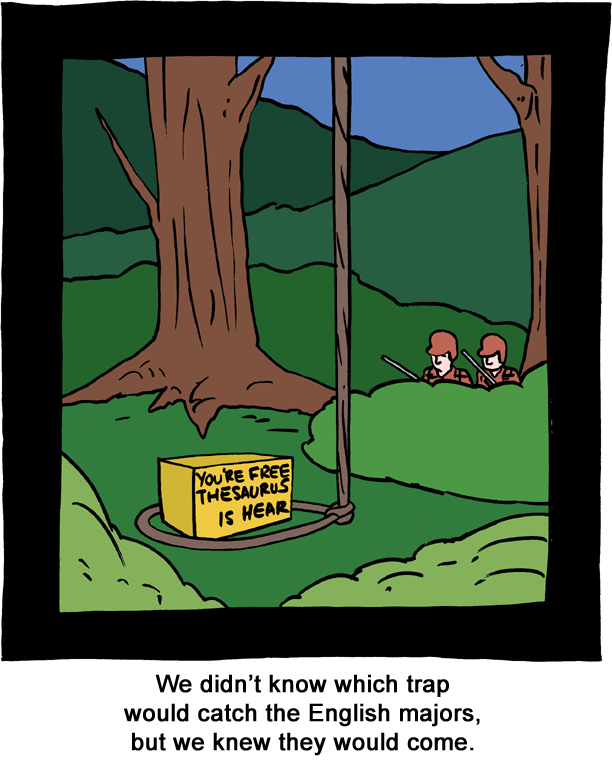
Oh English Majors . . .

From Saturday Morning Breakfast Cereal

Thursday, December 13, 2012

"Poetry Makes You Weird"

I love this. 
 I had revealed to them, though I didn't know it then, the great payoff of literary study: It estranges us from our normal habits of thought and perception, nullifies old conceptual maps, and so propels us into uncharted regions, outlandish and bracing, where we must create, if we are to thrive, coordinates more capacious, more sublime than the ones we already know. The uncanny—not truth, beauty, or goodness—is literature's boon.
. . . 
Shelley articulates literature's invigorating disorientation: "Poetry lifts the veil from the hidden beauty of the world, and makes familiar objects be as if they were not familiar." But the result of that alienation is not only an aesthetic rush; it is also a moral life. In shocking us into awareness, poetry urges us to relate to the world in fresh ways. The problem is, How do I connect my own mind, relatively familiar, with what is before me, enticingly bizarre? 
Shelley answers: Imagine what it's like to be what you perceive. To accomplish that connection requires "a going out of our nature, and an identification of ourselves with the beautiful which exists in thought, action, or person, not our own." I take that to mean that the more distinctly we imagine the plight of another, the more empathy we feel, and the more beauty we appreciate. As Shelley put it, "The great instrument of moral good is the imagination; and poetry administers to the effect by acting upon the cause." 
. . . 
Walker Percy once wrote that our educational system has lost the "creature," treating specimens, whether Shakespearean sonnets or dissected frogs, merely as "examples" of ideas—of Poetry or Anatomy. We don't see the particular for the general, the trees for the forest. Percy recommends that biology teachers bring sonnets to class, and English professors, frogs: to stun abstraction, ignite the concrete. 
I'm too cowardly to tote amphibians down the hall. But I continue to hope that during a Monday-morning class, when the weather and the mood are right, I can chant Keats's reverie of the "murmurous haunt of flies on summer eves" and a drowsy student will jerk awake. Green-blue bugs will buzz eerily in his head. Suddenly nothing is right. Something has happened. 

Sunday, December 2, 2012

The costs and benefits of post-secondary education and income-based repayment

Don't get too excited; I'm not at all prepared to analyze the pros and cons of college and Income-based Repayment (IBR) in this post.  I just want to whine a bit about how we desperately need to start having a serious discussion about the value of post-high-school education.  

Certainly, I want to be surrounded by thinkers.  Given my druthers, I'd make high school a series of seminars on aesthetic, political, and moral philosophy.  I also love the idea of having an academy (in the sense of a university dedicated to study and research, divorced from the market).

And, certainly, some people go into higher education because they are passionate about their particular field (right here, baby!).  They should be able to do this; we need passion.  Most do not, however.  Most pursue higher education out of an interest combined with a desire to live the lifestyle (make the money) associated with the career in question.  And there is nothing wrong with that, either.  (Footnote: these entirely accurate numbers are based on tireless research conducted by me in which I make shit up.)

But when so many, for example, law students are graduating with debt that they will never be able to pay--when, that is, they are not getting out of the whole business what they were pursuing--what, exactly, is the point and who is bearing the cost?  Not, certainly, the schools, as this post on LG&M makes clear.


This is such a complicated question, dependent upon big ideas about society and social welfare and philosophic priorities, which is why it is hard to talk about.  And yet, we should be doing it anyway.


Sure, some people are having these conversations (the gentlemen on LG&M being a notable example), but those conversations have not yet gone wide enough.  This issue has very big and very real implications for a huge number of people, my students amongst them.  Those people should be in on the discussions and decision-making.

Lesson plan?

Thursday, November 22, 2012

Women and Law

This is a really interesting post by Lawyers, Guns & Money.  There were so many factors contributing to my decision to leave law, primarily, obviously, that I wanted a different, specific career.  Whether the gender inequality in the reality of the profession (that played out in, oh, so many delightfully ugly ways) was one of them is hard for me to tease out, but it certainly didn't make staying more attractive.

Clearly, the fact that law schools have produced an enormous oversupply of people with law degrees over the course of the last generation has an extremely significant gender component. These statistics raise all sorts of questions, and in particular this one: To what extent has legal academia’s over-expansion depended on the exploitation of the career aspirations of women in particular? Note that there’s all sorts of evidence that egalitarian gender practices in regard to law school admissions have had a remarkably muted effect in regard to making law less of a male-dominated profession (For example, 35 years after women started going to law school in numbers not much smaller than men, 85% of the partners and 95% of the managing partners at large law firms are men). 
Have law schools managed to expand far beyond the actual economic demand for law degrees in large part because of an always unstated and usually unconscious assumption that comparatively large numbers of women law graduates would drop out of the profession within a few years of graduation? One of the very few longitudinal studies of law graduate career paths suggests strongly this is the case. This study of the University of Virginia Law School class of 1990 found that while, 17 years after graduation, 98.7% of the men who responded to the survey were working full-time, approximately 63% of the women respondents who had had at least one child were not practicing law full-time. (By contrast, there was literally no correlation between the number of children a man had had and the likelihood that he would be employed full-time).

Monday, November 19, 2012

"Acts of incompletion, acts of fragmentary insight, . . . a kind of joyous invitation to reread"


I was mugged a couple weeks ago in broad daylight, pepper sprayed for my stupid phone. 

Today, I walked alone on the street for the first time since it happened.  Only a block or two to a bookstore, but I was proud.  And I forced myself to focus on the cool night air and the exhilarating sense of being out in the early dark of a fall evening.  I bought a poem for 50 cents out of a gumball machine, Old Bones by Gary Snyder.  And I stood in the doorway, facing out into the night and read and reread.
The key issue here is the sense of what cannot be analyzed or explained. A major act of interpretation gets nearer and nearer to the heart of the work, and it never comes too near. The exciting distance of a great interpretation is the failure, the distance, where it is helpless. But its helplessness is dynamic, is itself suggestive, eloquent and articulate. The best acts of reading are acts of incompletion, acts of fragmentary insight, of that which refuses paraphrase, metaphrase; which finally say, “The most interesting in all this I haven't been able to touch on.” But which makes that inability not a humiliating defeat or a piece of mysticism but a kind of joyous invitation to reread. - George Steiner
From Lit-Hum.org

Old BonesBY GARY SNYDER 
Out there walking round, looking out for food,
a rootstock, a birdcall, a seed that you can crack
plucking, digging, snaring, snagging,
         barely getting by,

no food out there on dusty slopes of scree—
carry some—look for some,
go for a hungry dream.
Deer bone, Dall sheep,
         bones hunger home.

Out there somewhere
a shrine for the old ones,
the dust of the old bones,
         old songs and tales.

What we ate—who ate what—
         how we all prevailed.
 

Monday, September 10, 2012

"some such desperate and radical expedient as tearing your first tragic love story out of your heart and putting it on pages for people to see"

My friend is being brave and picking at scabs and pulling out old, gnarled scar tissue. And I'm so proud of her.  Sometimes there is condescension in that phrase, but I don't intend it here.  I'm proud of her and proud to be her friend.  And my heart swells when she writes about tackling that deep down, dark and sticky tar that lines the heart and sits heavy in the soul and the stomach.  

Sometimes punctuation makes me want to cry.  I want to spend all day placing commas and periods and letting the weight of them sit on my chest like grief, and loneliness.

Her friend sent her this letter written by F. Scott Fitzgerald to a young friend of his who wanted to write.

And I want to give it to my students, and I want to give it to myself, and I want to write, and I want to do all the things.

Sometimes I wonder whether by asking our students to write their realities we are fetishizing their pain and their impoverishment.  But then I read this about writing, and I think probably not.  Because I think that what Fitzgerald describes as the "price of admission" to a life of writing is also the price of admission to a life well-lived.  Because it is only by looking straight at those things that haunt you, by grasping those things that bleed "as fresh as the skin wound on a haemophile," that, I don't know, you really live and really know life.

And, damn, even that searing pain, even the terror of turning around around, feels good compared to the other option, the not-feeling.


November 9, 1938

Dear Frances:

I've read the story carefully and, Frances, I'm afraid the price for doing professional work is a good deal higher than you are prepared to pay at present. You've got to sell your heart, your strongest reactions, not the little minor things that only touch you lightly, the little experiences that you might tell at dinner. This is especially true when you begin to write, when you have not yet developed the tricks of interesting people on paper, when you have none of the technique which it takes time to learn. When, in short, you have only your emotions to sell.

This is the experience of all writers. It was necessary for Dickens to put into Oliver Twist the child's passionate resentment at being abused and starved that had haunted his whole childhood. Ernest Hemingway's first stories "In Our Time" went right down to the bottom of all that he had ever felt and known. In "This Side of Paradise" I wrote about a love affair that was still bleeding as fresh as the skin wound on a haemophile.

The amateur, seeing how the professional having learned all that he'll ever learn about writing can take a trivial thing such as the most superficial reactions of three uncharacterized girls and make it witty and charming—the amateur thinks he or she can do the same. But the amateur can only realize his ability to transfer his emotions to another person by some such desperate and radical expedient as tearing your first tragic love story out of your heart and putting it on pages for people to see.

That, anyhow, is the price of admission. Whether you are prepared to pay it or, whether it coincides or conflicts with your attitude on what is "nice" is something for you to decide. But literature, even light literature, will accept nothing less from the neophyte. It is one of those professions that wants the "works." You wouldn't be interested in a soldier who was only a little brave.

In the light of this, it doesn't seem worth while to analyze why this story isn't saleable but I am too fond of you to kid you along about it, as one tends to do at my age. If you ever decide to tell your stories, no one would be more interested than,

Your old friend,

F. Scott Fitzgerald

P.S. I might say that the writing is smooth and agreeable and some of the pages very apt and charming. You have talent—which is the equivalent of a soldier having the right physical qualifications for entering West Point.